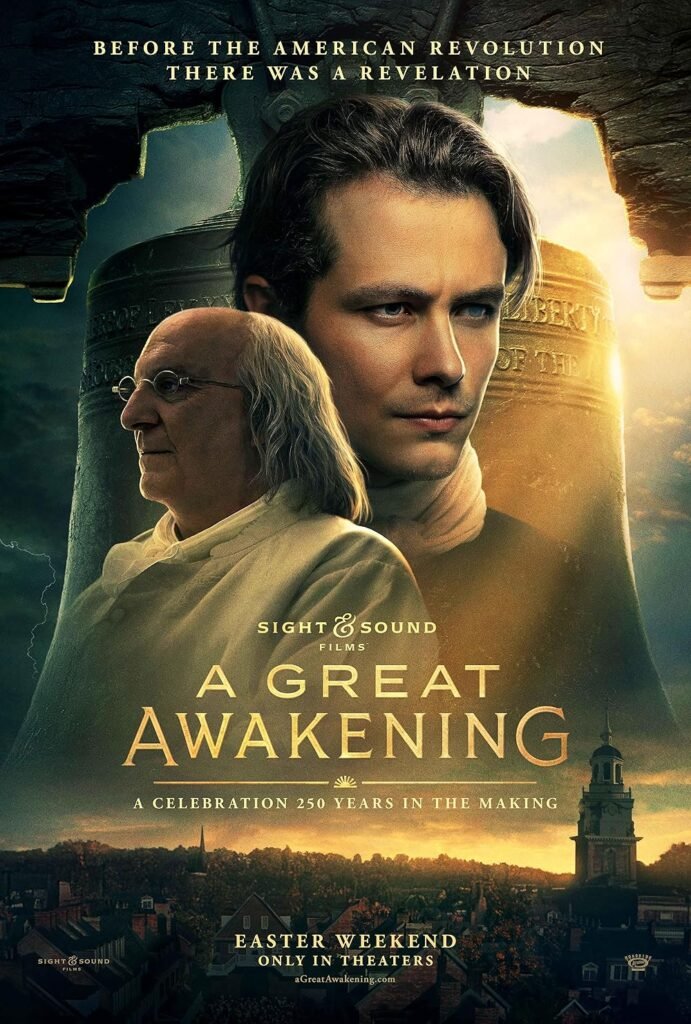

Films made for faith-based audiences often land in a strange place with critics: loved by the people they were made for, shrugged at or panned by the rest. A Great Awakening, a 2026 historical drama from Sight & Sound Films, fits that pattern. It tells the story of the friendship between evangelist George Whitefield and Benjamin Franklin in the years before the American Revolution, and it opened in US theatres on Easter weekend, April 3, timed to the nation’s 250th anniversary. This review covers the story, the filmmakers, the reception and who is likely to enjoy it.
I’m drawing on official material and published reviews, not a personal screening, and I’ll try to be fair to both the film’s aims and its critics.
The History Behind the Film

The first Great Awakening was a wave of religious revival that swept the American colonies in the 1730s and 1740s, and George Whitefield was one of its most famous preachers. Benjamin Franklin, a skeptic about religion, nonetheless admired Whitefield’s ability to move crowds and printed his sermons in The Pennsylvania Gazette. That unlikely friendship is the heart of the film.
The film’s pitch is that the revival helped shape the identity of the colonies before the Revolution. The official synopsis frames Whitefield’s sermons as uniting a generation with a proclamation of liberty, and it presents the idea that true liberty must be awakened in people’s hearts, not just written into law (Religion News Service).
Who Made It
A Great Awakening is the second feature film from Sight & Sound, a Lancaster, Pennsylvania company long known for large-scale, faith-centred stage productions. It follows I Heard the Bells (2022), which grossed $5.6 million in its run, and the production company’s earlier theatrical release Noah. Roadside Attractions acquired domestic distribution rights and gave it a wide release over Easter weekend (Chester County coverage).
Joshua Enck directed, with a script by Jonathan Blair, Joshua Enck and Jeff Bender. Blair also plays Whitefield. The runtime is about two hours and nine minutes, and it’s rated PG-13.
The Cast
Jonathan Blair plays George Whitefield, and John Paul Sneed plays Benjamin Franklin. The ensemble includes Josh Bates as Alexander Hamilton, JT Schaeffer as Benny Franklin Bache, and a roster of supporting actors playing other founding-era figures such as William Blount, Caleb Strong and Robert Yates. That mix of colonial and constitutional-era names suggests the film moves across a long stretch of history.
For viewers who like American-history dramas, the cast is a reminder that the genre has plenty of precedent, from 1776 to John Adams.
What Critics Are Saying
The one in-depth negative review I found is very harsh. HighOnFilms calls the film a somniferous experience and an endurance test. It argues that the film is so convinced of its own righteousness that it becomes a nuisance, and that the way it delivers its message is caught up in pomposity. It describes the pairing of Christian benevolence and American industriousness at the film’s core, but finds the storytelling flat and dull.
That’s one review, and a strongly worded one. Audience-facing sites show a very different picture: one streaming guide lists an audience-style score around 7 out of 10 and summarises the film as an uplifting, faith-forward historical drama about friendship, public speeches and the idea of liberty taking root in ordinary people. Its list of cons is blunt, though: a heavy sermon emphasis, an earnest tone throughout and familiar historical beats.
The gap between those readings is worth noting. A film made for a faith audience may succeed on its own terms even when critics don’t connect with it.
What Works
The premise. A friendship between a fiery preacher and a practical, skeptical publisher is genuinely interesting, and it has a built-in dramatic tension between faith and doubt.
The timing. Released as the US marks 250 years since the Declaration of Independence, the film taps into a national conversation about origins.
The ambition. Stage producers moving into film is a hard transition, and this is a large-scale attempt at period drama.
Its audience. For viewers who want faith-centred historical storytelling, there aren’t many recent theatrical options.
What Doesn’t
Pacing. Critics find the film slow and static, with long stretches of speeches in place of drama.
Tone. An earnest, sermon-heavy approach can feel preachy to viewers who aren’t already on board.
Familiarity. The historical beats are well known, and the film doesn’t offer much surprise.
Scope. A two-hour-plus runtime covering decades of history risks feeling episodic.
Who Should Watch It
The film is aimed at viewers who enjoy faith-based dramas, church groups and family audiences, and history enthusiasts curious about Whitefield and Franklin. If you want a tightly plotted, secular take on the founding era, there are better options.
Where to Watch
A Great Awakening opened in US theatres on April 3, 2026, and streaming availability varies. One guide noted it wasn’t available on major US streaming services at the time of listing, so check your preferred platform.
FAQ
Is A Great Awakening a true story? It’s based on real events and the real friendship between Whitefield and Franklin, with dramatization.
Who made it? Sight & Sound Films, with Roadside Attractions handling US distribution.
Is it family-friendly? It’s rated PG-13.
How long is it? About two hours and nine minutes.
Final conclusion
A Great Awakening is a heartfelt, earnest film that critics found heavy going. If you’re part of its intended audience, or you love early-American history, you may get more from it than the harshest review suggests. If you’re looking for a gripping drama, I’d look elsewhere.


