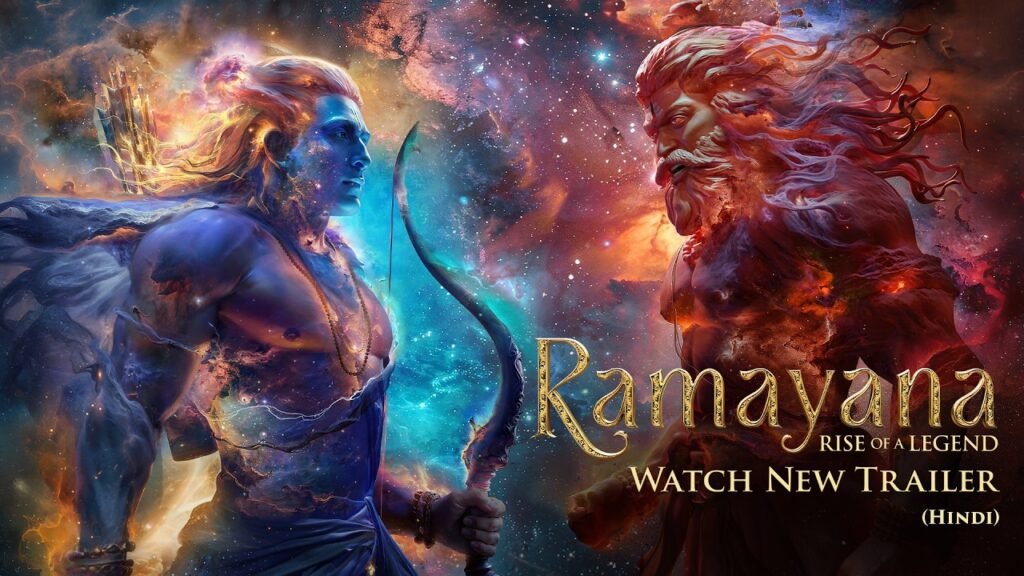

Ramayana advance booking has crossed Rs 16 crore in India, and with exactly one week to go before release, Nitesh Tiwari’s epic is now selling tickets at a pace that few Indian films ever reach before their first show. The numbers, tracked by Sacnilk on the evening of 29 October 2026, show a film that audiences are not waiting to judge after release. They are booking first, and asking questions later.
That is the story of this week for Ramayana: Rise of a Legend. The film releases worldwide in cinemas on Thursday, 5 November 2026, and its advance booking opened well in advance. A week out, the Ramayana advance booking figures already look like the opening of a major event film, not just another big release.
Ramayana advance booking: the headline numbers
According to Sacnilk’s snapshot updated at 8:00 pm IST on 29 October 2026, total pre-sales in India stood at Rs 16.38 crore including block seats, or Rs 13.55 crore without them. Block seats are seats held back by theatres and exhibitors, so trade trackers report both figures, and the gap between them is normal at this stage. Either way, the film had sold about 3.18 lakh tickets across 6,528 shows, with overall occupancy of around 21 per cent for the shows on sale.
The pace is worth noting too. Sacnilk’s movement data shows advance booking grew by Rs 1.43 crore in the previous 24 hours, and by more than Rs 81 lakh since 6:00 am on 29 October alone. That kind of daily addition, a full week before release, is what separates a genuinely anticipated film from one that is merely heavily promoted. People are not just talking about Ramayana. They are paying for it.
It is important to be clear about what these figures are, and what they are not. Advance booking is a measure of early demand, not a final box office result. The numbers will keep moving every hour until the first shows on 5 November, and they can still rise sharply in the final three or four days, when most Indian audiences actually book. What the current figures prove is momentum. They do not guarantee how the film will perform once reviews and word of mouth arrive.
Hindi leads, but Kannada is the surprise second market
Hindi is driving the Ramayana advance booking, as expected for a film headlined by Ranbir Kapoor. Sacnilk’s language split puts Hindi at Rs 13.62 crore, about 83 per cent of the total, from 5,988 shows. That dominance reflects both the film’s Hindi-first campaign and the size of the Hindi theatrical market.
The more interesting story is in second place. Kannada advance booking stands at Rs 2.22 crore, around 14 per cent of the total, from 428 shows. That is a strong showing for a version led by Yash, who plays Ravana, and it underlines how much of this film’s appeal crosses language lines. Yash’s presence gives the Kannada version a genuine star pull of its own, rather than treating it as a dubbed afterthought.
Telugu advance booking, at Rs 49.19 lakh from 77 shows, and Tamil, at Rs 4.58 lakh from 35 shows, are much smaller so far. That does not mean those markets are weak. It more likely means fewer shows have opened for booking there yet, and that their sales will build as more screens and show timings are added closer to release. Watch those two languages in the final days, because a wider release there could lift the total considerably.
Premium formats are doing the heavy lifting
If there is one detail that explains the Ramayana advance booking better than any other, it is the format split. Premium formats, including IMAX, 4DX, Dolby Cinema and similar large-format screens, already account for Rs 4.30 crore, about 26 per cent of the total, from just 341 shows. Audiences are choosing the biggest, most expensive screen available, not the cheapest ticket.
IMAX 3D alone is the standout. Sacnilk puts IMAX 3D at Rs 3.15 crore from 151 shows, with occupancy of 61 per cent, far above the overall average of 21 per cent. Dolby Cinema shows are even fuller, at 81 per cent occupancy, though from only 14 shows. 4DX 3D is at 54 per cent occupancy. In plain terms, the people booking earliest are the ones who want the spectacle, and they are willing to pay premium prices for it.
The standard 3D version still makes up the largest share, at Rs 10.12 crore, or 62 per cent, from 4,472 shows, while 2D accounts for Rs 1.78 crore. That balance makes sense. Most viewers will watch the film in 3D, but the premium screens are where demand is tightest, and they are likely to be the first to sell out in major cities. Anyone planning to watch Ramayana in IMAX on the opening weekend should probably book sooner rather than later.
Where the Ramayana advance booking tickets are selling
Geography tells its own story in the Ramayana advance booking. Karnataka leads the state-wise figures at Rs 3.32 crore, just ahead of Maharashtra at Rs 3.24 crore and Delhi at Rs 2.95 crore. Bengaluru alone accounts for Rs 2.67 crore, with occupancy of 34 per cent, making it the strongest single city so far. Mumbai follows at Rs 2.22 crore, then Hyderabad at Rs 88.33 lakh, where occupancy is a remarkable 67 per cent from only 103 shows.
Delhi NCR, combining Delhi’s figures with its surrounding region, was also reported by Zoom TV on 29 October as the leading region in an earlier snapshot of the day, at Rs 2.87 crore, followed by Bengaluru and Mumbai. The small differences between the Zoom and Sacnilk snapshots simply reflect the time of day they were taken. Advance booking figures move hourly, and both sources agree on the bigger picture: the metros are leading, and southern cities are punching above their weight.
Telangana, Gujarat, West Bengal, Uttar Pradesh, Rajasthan, Odisha and Punjab all feature in the top states list, each contributing between about Rs 47 lakh and Rs 88 lakh so far. That spread matters, because it shows the film is not dependent on one city or one region. A wide base gives it a better chance of holding up after the opening weekend, when local word of mouth starts to matter more than national hype.
Overseas Ramayana advance booking crosses $800K for the premiere
The Ramayana advance booking story is not limited to India. Sacnilk reported on 29 October that North America advance sales had crossed $800,000 for the premiere alone, after a surge following the film’s world premiere in Los Angeles on 27 October 2026. That premiere, held at the David Geffen Theater inside the Academy Museum of Motion Pictures, was an invitation-only 3D screening of the English-language presentation, and the reactions that followed appear to have pushed overseas bookings higher.
Earlier overseas tracking had already put total overseas advance booking above $2 million for the opening day, with North America contributing the largest share, followed by the UK and Australia. The North America premiere shows on 4 November, a day before the worldwide release, have been particularly strong, with premium formats again leading the way. For an Indian film, an overseas opening of this scale would put it among the biggest international launches of the year, and it explains why the makers have planned such a wide global release.
Zoom TV reports that the film is targeting a release across 50,000 screens in more than 100 countries, with Sony Pictures handling international distribution outside India and Dharma Productions handling the Hindi-speaking market. That is a target, not a confirmed final screen count, and the actual number will become clear only when the release week arrives. Even so, the ambition is obvious. This is being positioned as a global Indian epic, not a domestic release with a few overseas shows added on.
The film behind the numbers
For readers coming to this story fresh, Ramayana: Rise of a Legend is the first part of Nitesh Tiwari’s two-part adaptation of the epic. Ranbir Kapoor plays Rama, Sai Pallavi plays Sita, and Yash plays Ravana. Sunny Deol plays Hanuman, Ravie Dubey plays Lakshman, Lara Dutta plays Kaikeyi, Arun Govil plays King Dasharatha, and Rakul Preet Singh plays Surpanakha. The film is produced by Namit Malhotra’s Prime Focus Studios with DNEG and Yash’s Monster Mind Creations, and the music is by Hans Zimmer and A. R. Rahman.
The film has been certified U by the censor board, with an approved runtime of 3 hours and 15 minutes, and it will release in Hindi, Tamil, Telugu, Kannada and Malayalam, with an English version also prepared. That runtime and that scale are part of why the advance booking looks the way it does. A three-hour-plus epic in IMAX 3D is an event, and audiences are treating it as one.
Watch the official trailer below.
Why this Ramayana advance booking matters, and what it does not prove
Strong Ramayana advance booking helps a film in three practical ways. First, it gives exhibitors confidence to keep shows and screens with the film through the opening weekend, rather than moving them to a competing release. Second, it creates a sense of occasion, because sold-out shows and long queues become news in themselves. Third, it gives the film a cushion. Even if reviews are mixed, a large pre-sold audience means the opening day is already banked.
What it does not do is settle the film’s fate. Advance booking rewards anticipation, marketing and star power. Final box office rewards the film itself, and the audience response after the first shows. The first reactions from the Los Angeles premiere, covered in our earlier post, were largely positive about the scale and the lead performances, with some caution about pacing and music. Those reactions may help bookings, but they are not a substitute for full reviews or for the verdict of paying audiences across India.
The honest way to read the Ramayana advance booking today is this: the film has passed its first real test, which is getting people to commit money before release. The second test, which is whether those early viewers recommend it to others, starts on 5 November. Between now and then, expect the numbers to climb, expect IMAX shows in the big cities to fill up, and expect the daily updates to become a story of their own.
Frequently asked questions
When does Ramayana release in cinemas? Ramayana: Rise of a Legend releases worldwide in cinemas on Thursday, 5 November 2026, with premiere shows in North America a day earlier, on 4 November.
How much has Ramayana earned in advance booking so far? As tracked by Sacnilk on the evening of 29 October 2026, India pre-sales stood at Rs 16.38 crore including block seats, or Rs 13.55 crore without them, from about 3.18 lakh tickets. The figures keep moving hourly and are not the final box office.
Which version is selling the most tickets? Hindi leads with about 83 per cent of the India advance booking, followed by Kannada at about 14 per cent. Premium formats, especially IMAX 3D, are selling fastest, with IMAX 3D occupancy already above 60 per cent.
Who plays Rama, Sita and Ravana in Ramayana? Ranbir Kapoor plays Rama, Sai Pallavi plays Sita, and Yash plays Ravana. Sunny Deol plays Hanuman and Ravie Dubey plays Lakshman.
Is Ramayana advance booking open in IMAX? Yes. IMAX 3D shows are on sale and are among the fastest-selling formats, along with 4DX and Dolby Cinema. Standard 3D and 2D shows are also available.


Pingback: Don't Trouble The Trouble Netflix: 7 Lovely Reasons to Watch